
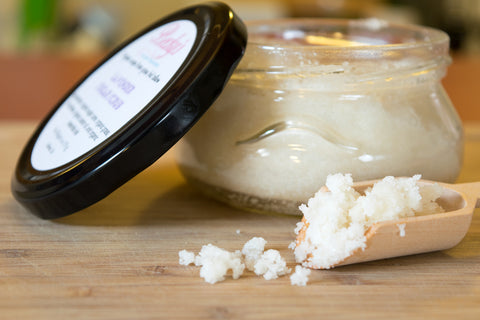
"Mamma? Can I eat your sugar scrub?" says my 5-year-old daughter. Bewildered, I ask, "What? Why???"
Her response? "Because it's yummy."
...I wonder how she knows it's "yummy." Hm, suspicious.
I pride myself in making products so clean you could eat them, but that doesn't mean that's what was intended. Although, that would explain the four people (yes, four people) who, to my shock and horror, ate my soap at the farmers' market. I supposed it does look like cheese. But, I digress.
An experiment was done to see the effects of pesticide build-up in the body. For the next two weeks, this family decided to eat only organic and measure the effect. Before they begin, the family takes urine samples and discover they have a number of insecticides, fungicides, and plant growth regulators inside their bodies.
I'm not merely talking about the amount of exposure one may succumb to by eating my soap... or sugar scrub. I'm referring to the old adage, "what goes into the pot, must come out." Or, maybe it's, "what goes up, must come down"?
The point is, if I put oils and herbs that contain pesticide residue into the soap pot, you can be sure that the pesticide residue is going into the soap in some way, shape, or form.
What do I mean by "in some way, shape, or form"? Good question. I'm glad you asked.
In short, some pesticides react with lye, while others do not.
A pesticide that does not react with lye will simply remain in the soap unaffected. You will get the - uh, pleasure? - of dousing bathing in these pesticides. Granted, soap is a wash-off product so it's not going to remain on the skin very long to soak in like a lip balm, tallow balm, or deodorant would, right? Right. Well, except for the trace amount in the oils that are left behind on the skin because of superfat which I explain in the post I Want A Moisturizing Soap With Lots Of Bubbles.
A pesticide that does react with lye will do two things to the soap. First, it takes the precious lye away from oils resulting in higher superfat -- this is minuscule (I hope). Second, the chemical reaction can create a by-product that's even more toxic than the initial pesticide that was added (source).
In both cases, whether the pesticides are reacting with the lye or not, it's going to end up on your skin.
A study on the toxic effects of pesticides on skin done collectively by Cornell University, Michigan State University, Oregon State University, and University of California at Davis states,
"Many pesticides can be absorbed through the skin into the blood, and can cause toxic effects [in the body]... In addition, pesticides can also injure the skin directly, a process known as cutaneous toxicity. Skin irritation and skin rashes produced by irritating chemical substances are a very noticeable type of chemical toxicity."
The more common symptoms of skin toxicity are primary irritant dermatitis and allergic contact dermatitis.
Primary irritant dermatitis is caused by the chemical substance directly irritating the skin. Symptoms can range from minor itching, pain, and redness to more severe symptoms such as blisters, with peeling and open wounds (ulcerations). This is why field workers cover up from head to toe when using pesticides. Not to mention that a splash of the pesticide on one's skin is enough result in death (source 1, source 2, source 3).
Allergic contact dermatitis is an allergic reaction that develops over time. Some may become allergic immediately after initial exposure while others develop an allergic reaction years later. I wonder how many people develop a rash without changing their routine and are left baffled at what could be causing such ailment. Also, how unfortunate it would be, in an attempt to soothe the irritation, to apply a pesticide-laced skin cream on the rash caused by pesticide residue in the first place.
Granted, the residue is in trace amounts. However, it's the same "trace" amounts that is on our food which accumulates in our body, and in our cosmetics which is absorbed through our body. While these may be the immediate effects of pesticides on the skin, the long term effects are still unknown. We can see how pesticides can build up in the body overtime and constant exposure (both inside and out) make it difficult, if not impossible, to detoxify. By choosing organic skincare, in addition to an organic, real food diet, we can reduce toxic intake and pamper the skin that keeps us looking healthy and youthful!
Thanks for reading!
Related Posts

Why I Don't Use Synthetic Fragrances

Shredded Luffa & Ground Coffee: Creative Skincare Options

From Devastation to Redemption: How SPYHOST Helped Me Recover $2 Million in Crypto
I’m writing this today with a heart full of relief and gratitude — emotions I couldn’t have imagined feeling just a few weeks ago.
Not long ago, I went through what I can only describe as the worst experience of my life, My crypto wallet — the one holding $2,045,000, essentially my entire life savings — was hacked. I was completely blindsided. One moment everything seemed fine, and the next, my wallet was empty.
It turns out I had been the target of a Remote Access Trojan (RAT)— a type of cyberattack that silently gives hackers full control over your device. They didn’t just steal my money; they shattered my peace of mind.
I was devastated, angry, and completely lost. I couldn’t eat. I couldn’t sleep. I thought, “How do you even begin to recover from something like this?”
That’s when I was referred to SPYHOST CYBERSECURITY COMPANY — a name I’ll never forget for as long as I live.
From the very first conversation, I could tell I wasn’t just dealing with tech experts — I was dealing with professionals who actually cared. They listened to my story without judgment and immediately got to work.
What followed was nothing short of incredible. Their team used a mix of memory forensics (RAM analysis), private key and decryption recovery, malware tracing, disk forensics, and network monitoring— things I barely understood, but they explained every step of the way.
Against all odds, they recovered my wallet. Yes — the full amount. Over two million dollars. I still get goosebumps just writing that.
I’ve dealt with tech support before. I’ve hired “experts.” But I’ve never met a group like SPYHOST — ethical hackers with the skill, speed, and transparency that truly set them apart. They didn’t just recover my funds; they restored my trust.
If you’re reading this and going through something similar — whether you’ve lost crypto, fallen victim to an investment scam, or had your accounts compromised — don’t give up. There are real professionals out there who can help. And from my experience, SPYHOST is one of the best.
You can reach them directly through:
WhatsApp: +1 (228) 313‑3152
Email: [Spyhost@cyberdude.com]