
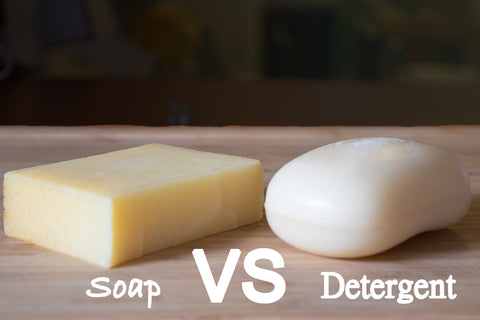
I've been asked before what's the difference between soap and detergent. After giving my proof-readers a little taste of chemistry, I noticed their eyes began to look like doughnuts... glazed. To hopefully make things more understandable, I have included pictures that my kids I drew. OK... yes, I drew them.
Surfactants
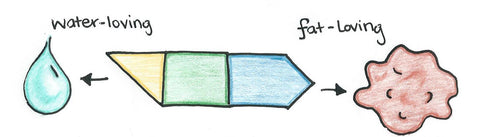
Both soaps and detergents are known as surfactants (short for surface-active agents). Surfactant molecules contain a lipophilic (fat-loving) end that attaches grease dirt and a hydrophilic (water-loving) end which makes the molecule dissolve in water. The electrical charge on the water-loving end of the molecule distinguishes between the different types of surfactants. Surfactants come in four different types: anionic, nonionic, cationic, and amphoteric.
Soap
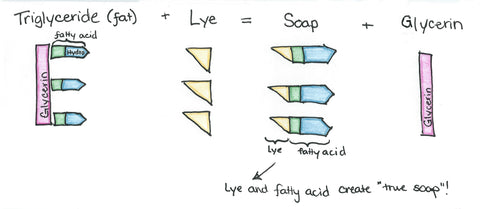
Soap, by definition, is the product of a fat and an alkali -- usually sodium or potassium hydroxide. Fat, made of triglycerides, is composed of three fatty acids (hence the prefix "tri-") connected to one glycerin (hence "glyceride"). There are many types of triglycerides; each type consists of its own particular combination of fatty acids.
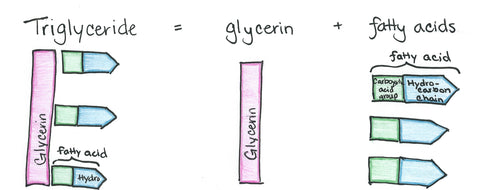
It is the fatty acid part that reacts with sodium or potassium hydroxide that creates a soap with the glycerin left behind.
Detergent
Detergents are created in a multi-step process -- making a completely synthetic substance. It's literally called a "slurry mixture" when being developed.
It contains a hydrocarbon (which is a fraction of a fatty acid, which is a part of a triglyceride/whole fat) from either a petrochemical, derived from petroleum, or an oleochemical, derived from fat and oils. The hydrocarbon will become fat-loving end of the surfactant.
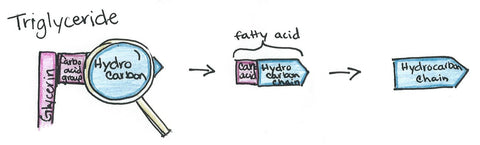
Other chemicals, such as sulfur trioxide, sulfuric acid, and ethylene oxide, are used to produce the water-loving end of the surfactant molecule. The hydrocarbon plus the other chemicals creates the new, synthetic acid which is ready to be mixed with another agent.
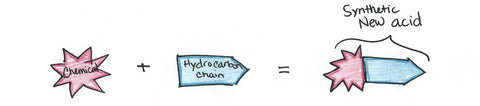
Sometimes it is mixed with ethylene oxide to create a nonionic surfactant. Other times it is mixed with an alkali - usually sodium or potassium hydroxide - to make an anionic surfactant. However, the differences in detergent ions is going beyond the scope of this post.
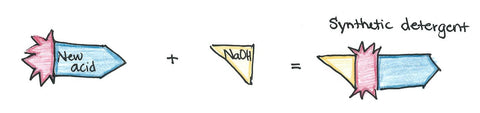
I'd like to point out that the creation of detergents does not include glycerin which is why we use conditioner after shampoo and lotion after body wash. They not only remove oils which are our protective barrier, but also fail to moisturize (via glycerin) nor leave a moisturizing barrier behind. Additionally, the Journal of the American College of Toxicology (1983, Vol. 2, No. 7), has noted that detergents are skin irritants as well.
In labeling, detergents may not be called soap. It does not contain a full fatty acid (only a hydrocarbon) and it may or may not even use an alkali. It's completely synthetic. It does not fit the definition of a soap; it's a detergent. However, this doesn't stop clever marketers from calling their product "beauty bar," "anti-aging moisturizing bar," or "deodorant bar." This also doesn't stop marketers for wanna-be-natural products to say their sodium lauryl sulfate is all-natural because the hydrocarbon came "from coconut oil."
Often times people use the word "soap" when referring to anything that cleans -- for example, "dish soap," "hand soap," "anti-bacterial soap," etc. However, this can be detrimental for one's understanding because, unlike real soap which mechanically removes dirt AND kills bacteria, detergents can only physically remove dirt. You can learn more about detergents in my next post!
Thanks for reading!
Related Posts

How To Use A Shampoo Bar -- And Why You Should

The Lowdown On (So-Called) "Tear-Free Soap"

https://www.instagram.com/p/Dbare_kjXqo/
https://www.molecularcloud.org/p/next-level-prep-insurance-institute-c11-questions-2026
https://www.molecularcloud.org/p/brand-new-release-c130-questions-2026
https://www.molecularcloud.org/p/pro-level-trending-insurance-institute-c131-questions-2026
https://www.molecularcloud.org/p/brand-new-viral-scrum-psm-iii-questions-2026
https://elearn.ellak.gr/mod/forum/discuss.php?d=65558
https://elearn.ellak.gr/mod/forum/discuss.php?d=65561
https://elearn.ellak.gr/mod/forum/discuss.php?d=65562
https://elearn.ellak.gr/mod/forum/discuss.php?d=65564
https://elearn.ellak.gr/mod/forum/discuss.php?d=65565
https://elearn.ellak.gr/mod/forum/discuss.php?d=65566
https://elearn.ellak.gr/mod/forum/discuss.php?d=65568
https://elearn.ellak.gr/mod/forum/discuss.php?d=65569
https://elearn.ellak.gr/mod/forum/discuss.php?d=65570
https://elearn.ellak.gr/mod/forum/discuss.php?d=65572
https://elearn.ellak.gr/mod/forum/discuss.php?d=65579
https://elearn.ellak.gr/mod/forum/discuss.php?d=65580
https://elearn.ellak.gr/mod/forum/discuss.php?d=65581
https://elearn.ellak.gr/mod/forum/discuss.php?d=65583
https://elearn.ellak.gr/mod/forum/discuss.php?d=65584
https://elearn.ellak.gr/mod/forum/discuss.php?d=65586
https://elearn.ellak.gr/mod/forum/discuss.php?d=65587
https://elearn.ellak.gr/mod/forum/discuss.php?d=65589
https://elearn.ellak.gr/mod/forum/discuss.php?d=65590
https://elearn.ellak.gr/mod/forum/discuss.php?d=65591
https://elearn.ellak.gr/mod/forum/discuss.php?d=65604
https://elearn.ellak.gr/mod/forum/discuss.php?d=65605
https://elearn.ellak.gr/mod/forum/discuss.php?d=65606
https://elearn.ellak.gr/mod/forum/discuss.php?d=65607
https://elearn.ellak.gr/mod/forum/discuss.php?d=65608
https://www.molecularcloud.org/p/b2b-solution-architect-dumps-top-pick-2026
https://www.molecularcloud.org/p/top-salesforce-b2c-commerce-developer-dumps-for-career-growth-2026
https://www.molecularcloud.org/p/best-quality-salesforce-b2c-solution-architect-dumps-updated-content-2026
https://www.molecularcloud.org/p/bcba-dumps-100-verified-2026
https://www.molecularcloud.org/p/hot-nokia-bl0-100-dumps-newly-updated-2026
https://www.molecularcloud.org/p/fast-track-ibm-c1000-138-dumps-for-smart-preparation-2026
https://www.molecularcloud.org/p/best-value-pmi-capm-dumps-updated-resources-2026
https://www.molecularcloud.org/p/skill-fully-bci-cbci-dumps-excellent-certification-prep-2026
https://www.molecularcloud.org/p/top-iiba-cbda-dumps-for-career-growth-2026
https://www.molecularcloud.org/p/skill-fully-confluent-ccaak-dumps-excellent-certification-prep-2026
https://www.molecularcloud.org/p/top-ranked-crowdstrike-cccs-203b-dumps-trusted-worldwide-2026
https://www.molecularcloud.org/p/affordable-scdm-ccdm-dumps-2026
https://www.molecularcloud.org/p/fast-track-acmp-global-ccmp-dumps-for-smart-preparation-2026
https://www.molecularcloud.org/p/instant-asq-ccqm-dumps-start-learning-today-2026
https://www.molecularcloud.org/p/fast-track-apse-cesp-dumps-for-smart-preparation-2026
https://www.molecularcloud.org/p/proven-nfpa-cfps-dumps-first-attempt-success-2026
https://www.molecularcloud.org/p/featured-certnexus-cfr-410-dumps-real-exam-experience-2026
https://www.molecularcloud.org/p/chrp-ke-dumps-100-verified-2026
https://www.molecularcloud.org/p/latest-cima-cimapra17-ba1-1-dumps-fully-updated-2026
https://www.molecularcloud.org/p/skill-fully-iapp-cipp-c-dumps-excellent-certification-prep-2026
https://www.molecularcloud.org/p/top-servicenow-cis-em-dumps-for-career-growth-2026
https://www.instagram.com/p/DbYGDeiDeFF/