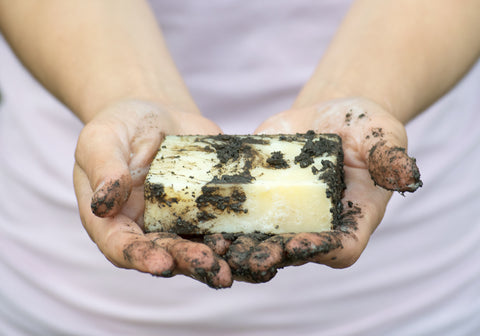
Are there germs lurking in your soap dish? Is sharing soap unsanitary? Can you get sick from your soap? These are some of the questions I get asked about using a bar of soap. You want answers, and you've come to the right place. Take a seat as we dig up the dirt on soap.
After the first awareness to antibiotic-resistant Staphylococci, in 1947, researchers have been searching for factors contributing to the "staph problem" and attention has been placed on objects which could be transferring the disease. They found abundant bacteria on "bedding, floors, eating utensils, bathtubs, houseflies, air ducts, water carafes, mops, floor wax, sinks, water faucets, telephones, domestic animals, facial tissues (not used), and even bank notes." It sounds like a recipe for a disease outbreak.
Since reducing hospital-related outbreaks depends entirely on the cleanliness of the facility, a series of studies in 1965, a study in 1988, as well as the initial conclusion by Koch in 1881, were performed to determine whether or not bar soap (without antibacterial additives) aided or inhibited the spread of disease. The following are studies done on true soap (fat & alkali), not on a bar of detergent. We'll talk about the effectiveness of detergents in another post.
Study 1 -- Self-Sterilizing Capacity of Bar Soap
Several different organisms were introduced to the surface of bar soap and left in a saturated humidity chamber to encourage bacterial growth for 18-24hrs then sampled after a length of time to determine their viability. They were tested at several minute intervals to find that the bacteria decreased by 100,000 fold in 15 minutes.
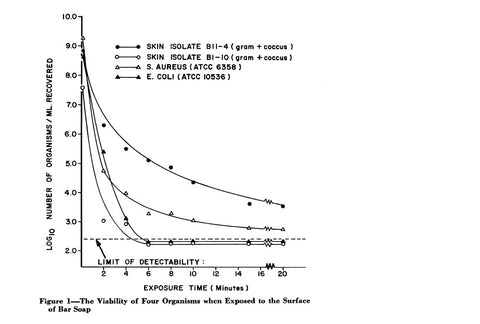
From Figure 1 above, we see Staphylococci aureus nearly eliminated, while E coli. is no longer detectable. Even when encouraged to grow by saturating a soggy bar of soap with humidity, they continued to die.
Study 2 -- Transmissibility of a Tracer Bacterium by Bar Soap
This study was conducted by the participants dipping their hands in a bacteria solution that heavily contaminated their hands to 1,000 times the amount that is normally found on skin. The first person is to wash their hands, then immediately pass the soap on to the next participant with heavily contaminated hands to see if bacteria can still be transferred before expiring on the bar of soap.
The bacteria solution chosen was Serratia marcescens because it's easy to differentiate from bacteria normally found on the skin, it adheres readily to the skin, and it's hardier against soap.
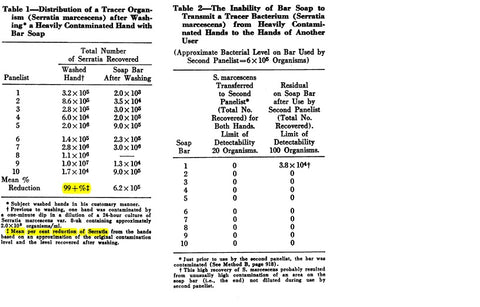
Table 1 shows that there was a 99% reduction of bacteria on the skin with even the most heavily contaminated hands, although, it transferred bacteria to the soap. However, Table 2 shows that despite that there was bacteria transferred to the soap, it wasn't picked up by the second user. I don't know about you, but I'm impressed.
Study 3 -- Accumulation of Bacteria on Soap During Actual Usage
Bars of soap were left at large office-laboratory building for several hours to see if bacteria accumulated and build up occurred on the bar of soap during actual heavy use.
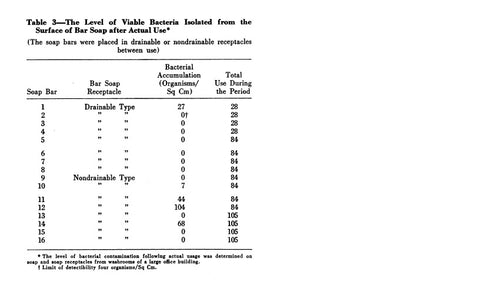
Table 3 shows that despite the slight accumulation of bacteria in a non-draining dish compared to a well-draining dish, no significant build-up occurred as a result of heavy hand washing.
Historically, soap revolutionized the medical industry when physicians began washing their hands and the patient before surgery (source, section 13.5). Florence Nightingale laid the foundation of nursing by separating the wounded from the sick, bathing patients, and handwashing which greatly improved hygiene in the hospital and reduced deaths from 42% down to 2% (source).
Soap works in two ways. It physically cleans surfaces by mechanically removing dirt. However, because of the high pH, it is also inhospitable to microbial growth making it a disinfectant as well.
The points to take away from these studies:
- Bar soap is inherently bactericidal by it's chemical nature
- Bar soap does not support the growth of bacteria
- Bar soap does not transfer bacteria from person-to-person
- Bar soap used even in the most extreme conditions still does not pose a health hazard
It can be left in standing water, rubbed in dirt, or used by someone very ill, yet the contaminates will not be passed along. The "dirty" truth about soap is that it truly does the dirty work.
Naturally preservative-free, moisturizing, and reduces disease? Yeah, that's something I can live with!
Thanks for reading!
Related Posts
Activated Charcoal: Everything You Need To Know
Why I Don't Use Synthetic Fragrances
在線購買雅思證書 (微信 ID:Wesbutman) 購買GREE、NCE、雅思、托福、PTE、CPSO、學位及其他文件。我們也提供文憑(NCE)(PMP、NEBOSH、NCLEX、CIPT)和其他語言證書(微信ID:Wesbutman)(雅思、PTE、CELPIP、歌德)(WhatsApp:+49 1521 5066462)。在線購買有效的雅思、歌德、托福、PTE、托業、CELPIP證書,立即購買NCLEX-RN和NCLEX-PN。對於有志成為美國註冊護理師的人來說,無需參加考試即可通過NCLEX至關重要。透過我們的綜合指南,探索通往成功護理職業生涯的道路。 (WhatsApp:+49 1521 5066462) https://firstdocumentsonline.com/
在新不倫瑞克省購買正版雅思和CELPIP證書,(微信ID:Wesbutman) 購買CELPIP證書,購買真實雅思證書,購買雅思,在西北地區購買註冊GRE證書。在加拿大新斯科細亞省購買正版GMAT證書 – 在新斯科細亞省無需考試即可購買CELPIP證書 – (微信 ID:Wesbutman) 在加拿大努納武特地區購買雅思、GRE、CELPIP、CISSP證書(郵箱:wesbutman0@gmail.com)
線上購買PTE證書、托福證書、(微信ID:Wesbutman) GMAT證書、CAE證書、SAT證書,出售已註冊的CELPIP證書,無需考試即可獲得PTE證書,購買正版NEBOSH證書,在線購買CAE證書,在線購買托福證書,出售已註冊的PMP證書,在線購買GRE證書,在線購買GMAT證書。購買正版雅思證書(WhatsApp:+49 1521 5066462),無需考試即可獲得NEBOSH證書。
https://firstdocumentsonline.com/buy-italian-passport-online/
https://firstdocumentsonline.com/buy-real-polish-passport/
https://firstdocumentsonline.com/buy-real-estonian-passport/
https://firstdocumentsonline.com/buy-real-czech-passport/
購買真假護照, 購買正品美國護照、加拿大護照(微信ID:Wesbutman)、韓國護照、香港護照、台灣護照、中國護照、日本護照、泰國護照、波蘭護照、澳洲護照、英國護照(WhatsApp:+49 1521 5066462)、挪威護照、馬來西亞護照、法國護照、捷克護照、巴西護照、愛沙尼亞護照、身分證(真/假)、台灣身分證、(微信ID:Wesbutman)台灣駕照、泰國駕照、泰國證件(真/假)、簽證(真/假)、美元(假)、人民幣( 5066462).在線購買雅思證書。在線購買托福證書。在線購買PTE證書。在線購買ESOL證書。在線購買GRE證書。在線購買CELPIP證書。在線購買GMAT證書。在線購買PMP證書。在線購買NCLEX證書。https://firstdocumentsonline.com/
(WhatsApp:+49 1521 5066462)
(微信 ID:Wesbutman)
(Telegram:wesbutman0)
(信箱:wesbutman0@gmail.com)
https://firstdocumentsonline.com/
https://buytraveldocsonline.com/